Showing posts with label TC. Show all posts

Thursday

,


Apple has set a lofty goal for itself: use only renewable materials in its products to protect the environment and avoid “blood minerals.” In its 2017 Environmental Responsibility Report, released today ahead of Earth Day, the company said it is “challenging ourselves to one day end our reliance on mining altogether.” Greenpeace, however, thinks that’s not enough. The non-profit praised Apple’s commitment, but had a caveat: it also wants the company to make devices that last longer and are easier to repair.


In an interview with Vice News, Lisa Jackson, Apple’s vice president of environmental, policy and social initiatives, said “we’re actually doing something that we rarely do, which is announce a goal before we’ve completely figured out how to do it. So we’re a little nervous, but we also think it’s really important, because as a sector, we believe it’s where technology should be going.”


Using only recycled materials not only reduces environmental impact, but also helps prevent human rights abuses, such as the use of child labor to mine cobalt, which is essential for lithium-ion batteries, and minerals from conflict zones. (Apple recently stopped buying cobalt mined in Congo and audited its supply chain).


Other mined materials used in Apple products include aluminum, copper, tin and tungsten. In its Environmental Responsibility Report, Apple said “to start, we’re encouraging more customers to recycle their old devices through Apple Renew. And we’re piloting innovative new recycling techniques, like our line of disassembly robots, so we can put reclaimed materials to better use in new products. It’s an ambitious goal that will require many years of collaboration across multiple Apple teams, our suppliers, and specialty retailers—but our work is already under way.”


Of course, one reason why Apple is doing this is the publicity that will be generated if it is able to declare iPhones and other products conflict-free.


“I’d be lying if I didn’t say that one of the reasons that it appeals to us to use more recycled materials is that it gives us a different potential answer to that question,” Jackson, who served as the head of the Environmental Protection Agency from 2009 to 2013, told Vice News.


This may help Apple foster goodwill among consumers, who are starting to make more purchasing decisions based on social issues.


For many smartphone users, however, a sticking point is that Apple products, including iPhones, have a reputation for being harder to repair than devices from other manufacturers. Greenpeace called the company out on this issue, saying that “while transitioning to 100 percent recycled materials is critical to reducing the sector’s footprint, it is also fundamental for Apple and other major IT companies to design products that last, are easy to repair and recyclable at the end of life.”


Jackson told Vice News that “a lot of people buy Apple products because they know they do last.” But as the publication points out, electrical appliances in general have shorter lifespans than they did just a decade ago and that Apple itself says iPhones and Apple Watches are only supposed to last three years.


Still, Apple’s promise is a step in the right direction, even if the company still doesn’t know how exactly it will come to fruition. For one thing, it puts onus on competitors to keep up.


“This commitment, and Apple’s recent progress in transitioning its supply chain in Asia to renewable energy, puts it far ahead of others in the sector,” said Greenpeace in its statement. “Major IT brands such as Samsung, Huawei and Microsoft should quickly match Apple’s leadership, if they don’t want to risk falling even further behind.”


“Apple’s announcement comes less than a month after Samsung’s commitment to refurbish and recycle 4.3 million Galaxy Note 7s recalled worldwide, sending a strong signal to Samsung and the rest of the sector that much greater innovation is possible,” it added.


Featured Image: Zhang Peng/LightRocket/Getty Images


[ Source:-http://q.gs/DgVcg ]
,


Scientists are set to engage in a frivolous race of single-molecule “nanocars” on, if you can believe it, a solid gold track. It’s the boldest show of academic elitism and greatest waste of taxpayer dollars since the duck penis thing. Oh wait, it’s actually the greatest thing of all time.


The whole thing is a bit of a lark, thought up by chemists Christian Joachim and Gwénaël Rapenne as a way to drum up interest in the more prosaic aspects of nanotechnology, if you can really call them that.


Each “car” is a single molecule of perhaps a few dozen atoms, arranged in such a way that the electrons fired from the tip of a scanning tunneling microscope will propel them forward. This is accomplished in different ways by different nanocars: one might enter a higher energy state by absorbing the electron and deform, scooting it down the track. Another might be stable enough to repel the electron and be in turn propelled by it. (No pushing your car with the tip itself, that’s cheating.)


Some superficially resemble cars, but no one’s sure if wheels work the same at that scale, and there sure aren’t any engines — although the basic idea of a chassis with axles seems to apply.


This is how one car would go, ideally, but no one is really sure.


The track is a 100-nanometer-long piece of polished pure gold, so chosen because it is highly nonreactive, allowing all kinds of elements and configurations in the contestants’ molecules. It will be kept in a vacuum and as close to absolute zero as they can get it, since individual molecules tend to blow around a bit under ordinary circumstances.


There are two turns, which makes the course rather advanced considering these things have never even gone in a straight line before.


Some of the nanocar designs aiming to qualify.


This madness will all take place at the University of Toulouse, which has a four-headed STM, each head of which can drive one nanocar. So right now they’re running qualifiers to see which of six proposed designs from a variety of institutions will make it to the starting line.


No one really knows what will happen after that. The cars might disappear, break up, or go the wrong way. Japanese racer hopeful Waka Nakanishi admitted part of the reason she’s participating is to get her molecule under the university’s high-quality STM and find out what it’ll do. Sure, why not?


Every zap provided by the STM will be followed by a scan of the track, and every hour these scans will be uploaded as an animation, allowing fans to follow along in about as real time as you can expect from this ridiculous endeavor.


Curious? I knew you’d be. You can learn more at the project’s website or, if you speak French, in the video above. There’s even a BD!


[ Source:-http://q.gs/DgV4d ]
,


Google is planning to add an ad blocker to Chrome, its web browser, and to possibly turn it on by default for all users. That seems counterintuitive for a company that makes the majority of its revenue (read: all the monies) from advertising, but it could actually be a way to beat blockers by becoming one itself, per a new Wall Street Journal report that first reported the news.


If Google offers its own ad blocker in Chrome, targeting specific types of ads that users find particularly annoying, like pop-overs and autoplaying audio and video, those users might never seek out a third-party ad-blocking extension, the logic goes. The WSJ reports that Google doesn’t love the deals it often has to make with third-party blockers like Adblock Plus, which require payment of fees in some cases to whitelist ads by companies like Google who are willing to pay for the privilege of working around their filters.


Chrome’s widespread uptake by internet users means the browser has almost half of the market when it comes to navigating the web, so putting an ad blocker natively within Chrome and turning it on by default would basically stop cold the growth of third-party options: Users won’t actively seek out a way to block ads during their web-browsing sessions if the ads are already blocked to begin with.


It’s a plan that’s sort of akin to operating for years with very thin margins or at a loss to block out the competition, almost the way Amazon approached e-commerce. Google wouldn’t be aiming to eliminate advertising altogether, but a side-benefit for consumers might be the institution of more user-friendly acceptability standards for ads — if you turn off your ad blocker for a second, you’ll find it’s gotten pretty bad out there.


Of course, the plan offers plenty of potential pitfalls. As an advertiser itself, Google exercising stronger controls over ads will definitely draw criticism from industry peers, and possibly also from antitrust watchdog organizations. The WSJ says this isn’t yet a done deal, but if it does come, it might be announced sometime within the next few weeks (maybe at I/O in mid-May?), so we shouldn’t have to wait long to find out how much this rocks the online advertising industry boat.


Featured Image: Stephen Shankland/Flickr UNDER A CC BY-SA 2.0 LICENSE


[ Source:-http://q.gs/DgUnJ ]

Wednesday

,


Facebook will assemble an independent Ethical, Legal and Social Implications (ELSI) panel to oversee its development of a direct brain-to-computer typing interface it previewed today at its F8 conference. Facebook’s R&D department Building 8’s head Regina Dugan tells TechCrunch “It’s early days . . . we’re in the process of forming it right now.”


Meanwhile, much of the work on the brain interface is being conducted by Facebook’s university research partners like UC Berkeley and Johns Hopkins. Facebook’s technical lead on the project Mark Chevillet says “they’re all held to the same standards as the NIH or other government bodies funding their work, so they already are working with institutional review boards at these universities that are ensuring that those standards are met.” Institutional review boards ensure test subjects aren’t being abused and research is being done as safely as possible.


In any new technology you see a lot of hype talk, some apocalyptic talk, and then there’s serious work


— Regina Dugan, head of Facebook’s Building 8 lab


Regina Dugan presents at F8


Facebook hopes to uses optical neural imaging technology to scan the brain 100 times per second to detect thoughts and turn them into text. Meanwhile, it’s working on “skin-hearing” that could translate sounds into haptic feedback that people can learn to understand like braille. Dugan insists “None of the work that we do that is related to this will be absent of these kinds of institutional review boards.”


So at least there will be independent ethicists working to minimize the potential for malicious use of Facebook’s brain-reading technology to steal or police people’s thoughts.


During our interview, Dugan showed her cognisance of people’s concerns, repeating the start of her keynote speech today saying “I’ve never seen a technology that you developed with great impact that didn’t have unintended consequences that needed to be guard railed or managed. In any new technology you see a lot of hype talk, some apocalyptic talk, and then there’s serious work which is really focused on bringing successful outcomes to bear in a responsible way.”


In the past, she says the safeguards have been able to keep up with the pace of invention. “In the early days of the Human Genome Project there was a lot of conversation about whether we’d build a super race or whether people would be discriminated against for their genetic conditions and so on” Dugan explains. “People took that very seriously and were responsible about it, so they formed what was called a ELSI panel . . . By the time that we got the technology available to us, that framework, that contractual, ethical framework had already been built, so that work will be done here too. That work will have to be done.”


Building 8 R&D division head Regina Dugan at Facebook’s Area 404 lab


In just the span of a week, Facebook went from being criticized for not innovating and just copying Snapchat, to merely using its social network monopoly to squash the innovation of others, to innovating so far into the future that it scares us and conjures dystopic thoughts.


Worryingly, Dugan eventually appeared frustrated in response to my inquiries about how her team thinks about safety precautions for brain interfaces, saying “The flip side of the question that you’re asking is ‘why invent it at all?’ and I just believe that the optimistic perspective is that on balance, technological advances have really meant good things for the world if they’re handled responsibly.”


Facebook’s domination of social networking and advertising give it billions in profit per quarter to pour into R&D. But its old “Move fast and break things” philosophy is a lot more frightening when its building brain scanners. Hopefully Facebook will prioritize the assembly of the ELSI ethics board Dugan promised and being as transparent as possible about the development of this exciting-yet-unnerving technology.


[ Source:-http://q.gs/DgUTh ]
,


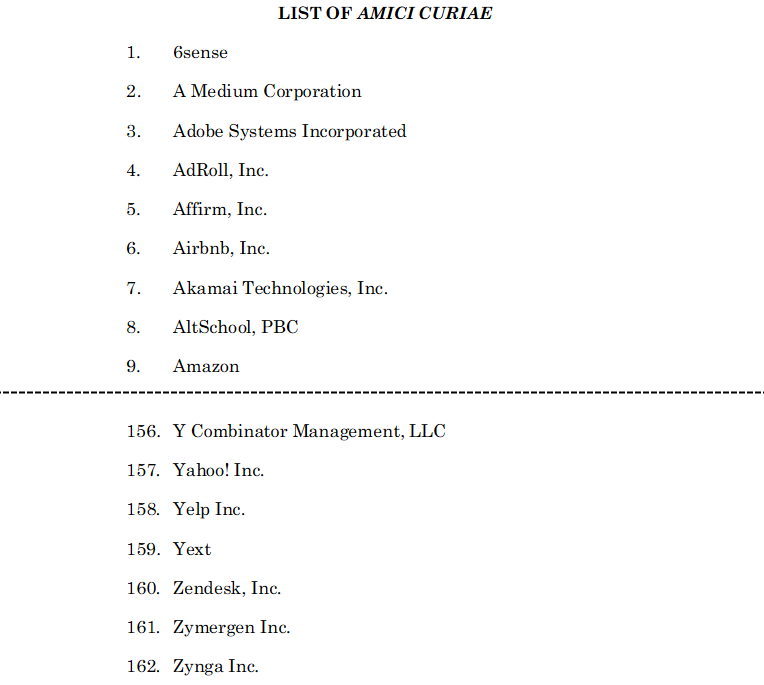
Silicon Valley and the tech community at large has been a staunch opponent of Trump’s immigration policies, from the “Muslim Ban” executive orders to H-1B restrictions. Today sees 162 companies banding together to file an amicus brief in support of a lawsuit challenging the revised immigration order issued in March.


Pretty much all the majors are listed as amici: Facebook, Google, SpaceX, Amazon, Salesforce, Microsoft, etc.


After describing for several pages the achievements of immigrants as far back as Nikola Tesla, the document lists its arguments for why the order is (still) unreasonable and unlawful.


Like the First Executive Order, the Second Order effects a fundamental shift in the rules governing entry into the United States, and is inflicting substantial harm on U.S. companies, their employees, and the entire economy.


The brief claims the order violates USC 1152, which requires that “no person shall… be discriminated against in the issuance of an immigrant visa because of the person’s race, sex, nationality,place of birth, or place of residence.”


The power of the President to ban certain persons from immigration temporarily is acknowledged, but described as totally out of line with the scope of the bill.


…the ban applies to literally millions of people who could not plausibly be foreign terrorists: hundreds of thousands of students, employees, and family members of citizens who have been previously admitted to the United States, and countless peaceful individuals who are citizens of or born in the targeted countries.


Trump’s second order, like the first, is facing legal challenges at the national level. The administration declined to further appeal the rejection of the first, instead opting to craft a revised version — which faces similar but possibly more manageable legal opposition.


Featured Image: Spencer Platt/Getty Images


[ Source:-http://q.gs/DgU4X ]
,


EBay reported first quarter results after the bell on Wednesday.


The company posted an adjusted 49 cents per share, when Wall Street was forecasting 48 cents. EBay reported revenue of $2.2 billion, when analysts were expecting roughly the same at $2.21 billion.


Gross merchandise volume, a measure of the total sales transactions of the platform came in at $20.9 billion, slightly beneath the $21.06 billion analysts had been expecting.


“The first quarter was a strong start to the year with accelerating growth in active buyers, revenue and our core U.S. business,” said Devin Wenig, President and CEO of eBay Inc, in a statement. “We are on the right path as we continue to evolve our shopping platform for consumers, leverage our technology advantages and market a sharpened eBay brand globally.”


The company also repurchased $350 million in common stock.


Shares closed Wednesday at $33.85, and went down about 3% in initial after hours trading. eBay shares have gone up 34% in the past year.


[ Source:-http://q.gs/DgTWK ]
,


I started going to therapy about five years ago, and it was quite possibly the best decision I had ever made. But at times, it was difficult to determine how much progress I was making on a week-to-week or even month-to-month basis.


Kip seeks to change that, by connecting its users with qualified therapists, and helping them track outcomes over time. By combining in-person therapy with a mobile app that allows patients to provide feedback on a day-to-day and week-to-week basis, the company believes it can improve the process for patients and therapists.


I had spent much of the last several years doing a traditional form of talk therapy, which had helped to work through relationship and work-related issues. But it took years of weekly sessions to unspool my personal history and determine how events in the past would affect how I react to current situations and interact with others, and to adjust my thinking around them.


In contrast, Kip is focused on evidence-based strategies like cognitive-behavioral therapy (CBT) and acceptance and commitment therapy (ACT), where patients work toward specific goals and outcomes can be tracked over time.


“We’re making therapy better because we’re giving therapists more data,” Kip co-founder Erin Frey told me. “We saw that in order to make real changes in the process, we needed to change things from the ground up.”


To figure out how well a therapist’s approach is working, Kip provides patients with a mobile app through which they provide daily and weekly updates on their progress. That data gets shared with therapists, who can use it to adjust course as necessary.


As someone who is seeking to overcome a certain amount of anxiety and depression — and really, what human isn’t dealing with some amount of anxiety or depression — I answer a series of questions each week that tackle how much and how often those feelings impacted me over the previous several days.


There’s also a daily questionnaire that just asks for my general mood, through which I can give an update on any major happenings on a day-to-day basis. And the system is customizable, allowing therapists to track other aspect’s of a patient’s life. For example: I’m trying to reduce my caffeine intake, so the app asks me to input how much coffee I’ve had over the course of a day.


Generally speaking, progress is never linear, but by tracking this data over time, Kip can create a trend line for a person’s well-being over time. “Therapists are professional debuggers of your brain… The more info they have, the more they can talk about and the better they can guide a session,” Frey said.


The tools they provide to therapists go beyond just the patient’s app and the data it collects. In addition to providing a platform for tracking patient data, it also provides a place for therapists to add their own notes over time.


“One of the reasons quality is so variable is that therapists don’t have easy tools to track outcomes,” Kip co-founder Ti Zhao told me. The belief is that doing so will make therapists more efficient with their time and help them to serve more clients better.


Mental health is a space that more startups are becoming interested in, and there are already a number of mobile-only therapy apps out there. Most aim to connect people with therapists they can text or do video sessions with, enabling therapists to serve more patients and allowing patients to have more active communication with their therapists.


Kip isn’t seeking to replace or supplant in-person therapy sessions with its app. As Frey points out, there are non-verbal cues and mannerisms therapists rely on while assessing patients that are difficult to pick up on through video chats and impossible to see in text-only interactions.


That said, Kip does allow users to share their thoughts with their therapist in-between sessions, and allows therapists to respond. It also is a way for patients to note things that they’d like to talk about the next time they meet their therapists. After all, the recency bias of “what happened today or yesterday” can too often consume more time in therapy sessions than more significant events which happened earlier in the week and might not be top of mind.


Kip is currently focused on serving patients in the Bay Area, and at $165 per session it’s not cheap. The company is also sidestepping a lot of the headaches that come with accepting insurance and connecting patients with therapists that get paid through the platform. The hope, though, is that as it grows over time the company will be able to show that its therapy is more efficient than methods using less data.


[ Source:-http://q.gs/DgTBw ]
,


From the stage of F8, Joaquin Quinonero, Facebook’s Director of Applied Machine Learning, described a new technique the company is using to improve the watching experience for 360 videos. The format is challenging to deliver because of its size, but Facebook is using machine learning to reduce the number of pixels that have to be rendered at any one time. By predicting where a viewer will look next, rendering priority can be given to that location  — particularly helpful for users with lower quality internet access.


The status quo for 360 videos is reactive rather than proactive rendering. Mike Coward, engineering director for Facebook’s VR video team echoed the frustration of users to me when he described the unpleasantness of turning your head in VR only to see a blurry scene.


One partial fix is to optimize compression. But teams at the company are already using machine learning to select across the thousand-plus compression techniques for individual snippets of video. The other way to reduce the streaming load is to just cut down on what you’re rendering. And rather than reduce quality across the board, Facebook’s approach improves resolution for exactly what you’re most likely to look at next.


Mike Coward, engineering director for Facebook’s VR video teamStep one was to use the resources of the company to monitor where people actually do look when watching 360 videos. Facebook’s VR video team created a heat-map that highlighted the most popular spots that users looked at within videos. From there, Facebook built a generative saliency map using a deep neural network. This model makes it possible to perform predictions on new videos that haven’t previously been watched or studied.


If a human were to be given the task of predicting where someone might look, they might study their natural environment and look for anomalies that could catch one’s interest — think birds or a car driving by.


Abstracting away to the neural net, the physical cars and birds cease to matter. Facebook’s model was trained on a massive corpus of videos to identify interesting subsets of a video frame. Coward told me that the model, when faced with a surfer in the ocean, is capable of picking selecting the surfer as most interesting, despite the fact that both are fast moving entities.


After implementing the prediction model, Facebook was able to increase resolution by 39 percent on VR devices. Aside from improving resolution and making 360 videos accessible to people without great network connections, the technology could some day make it possible to offer preemptive suggestions to creators on how to make videos more engaging.


[ Source:-http://q.gs/DgSop ]
,


Yo dawg, I heard you like basketball, so we built an AR basketball game you can play while you’re at a basketball game.


Ok fine, this isn’t how the Cleveland Cavaliers announced their new Augmented Reality game. But they should have.


Launching today, Deep in the Q (named after Cleveland’s Quicken Loans arena) is an AR basketball game launching just in time for playoffs. 


It’s pretty simple – the app opens to your camera, and once it recognizes a special trigger graphic it overlays an augmented reality basketball net.


A ball then appears which you can flick into the net. The AR tech is pretty good, letting you move your phone around and see the net (and shoot baskets) from all angles.


The game itself is really fun – the AR element makes it much more addicting than a 2D basketball game like the one Facebook recently snuck into messenger.


The Cavaliers plan to incorporate the app into their home playoff games by putting the graphic up on the main scoreboard during the game and letting fans shoot hoops from their seats. They’ll even give a prize to anyone who can make 10 shots in a row, which is definitely doable.


If you’re not at the stadium you can use their trigger graphic (shown below) to play at home. The game also recognizes the Bud Light logo as a trigger, so you can also play by just pointing your phone at a can or case of the beer. Since Bud Light is sponsoring the app you need to be 21 to play, and have to enter your birthday each time you restart the app, which a bit of a hassle.


The app was developed by YinzCam, a Pittsburgh-based app developer for sports teams. They’ve built apps for most of the teams in the NBA and NFL, as well as for events like the Super Bowl and NBA All Star Games.


You can download the app from the iOS App Store here, and use the trigger graphic below to play yourself right in this post.


[ Source:-http://q.gs/DgSL4 ]
,


As part of the NewTech Meetup we will be holding a very cool pitch-off at the Oskar Blues The Oak Room at 1800 Pike Road in Longmont, CO. It’s on Wednesday, April 19, 2017 starting at 6:00pm. The pitch-off will happen at about 7:30pm. You can RSVP here.


The companies pitching are Professor Beekums, Fringetime, TheChex, Matrix Analytics, Looplist, Oneroost,BuildingBrains, and Sibi.


The winner of the pitch-off gets a table at Disrupt New York and the second place company gets two tickets to Disrupt New York.


See you soon!


[ Source:-http://q.gs/DgRdq ]
,


If you’re a freelancer or self-employed person, you can now open a dedicated business account with N26 in just a few minutes. These business accounts are pretty similar to the consumer accounts with one additional feature — you get 0.1 percent cashback on all your card purchases.


Business accounts are available in all European countries where N26 already operates. You can’t open an account for a full-fledged company yet, but N26 says that more business features are coming soon.


Here’s a quick recap of what you can do with an N26 account. You can control your card in real time from the app. For instance, you can block foreign transaction or set a limit on ATM transactions because you rarely withdraw cash.


You can pay anywhere around the world with your N26 card without any exchange rate markup or foreign transaction fee. You can also get real time notifications of your transactions on your phone if you care about security.


N26 already has 300,000 customers. It’s clear that the startup wants to recreate a retail bank for European consumers first and foremost. In its current state, business bank accounts seem like an afterthought. But it’s interesting to see that it took little effort to customize the product for freelancers and self-employed persons.


Business bank accounts also seem like another market altogether. Startups like Qonto and Ibanfirst are committed to business bank accounts with a different set of features when you compare it to N26. But maybe the N26 for business bank accounts is going to be N26, after all.


As a side note, I’ve been using N26 as my main personal checking account for a few months now, and it’s been rock solid. I’m quite impressed with N26’s product offering. It’s clean, straight to the point and reliable. I consider my bank account as infrastructure, so that’s all I need.


[ Source:-http://q.gs/DgQZP ]
,


In recent years, Microsoft, Facebook and Slack (and many more) have all built new productivity platforms for workers to integrate and communicate about dozens of other API-enabled enterprise apps, but what about productivity tools for those enterprises that have no appetite or budget to rip out and replace software that they’ve been using for years? Well, there’s an app for that, too.


Sapho, which has developed a platform that lets you build “micro apps” for older legacy software packages (often without any APIs at all) to make them more useful and used (“as easy as using Facebook” is the pitch from CEO and cofounder Fouad ElNaggar), has picked up $14 million in a Series B round of funding — raised as the startup continues to pick up speed among enterprises using older software, growing revenues 320 percent and customers 200 percent in 2016.


Typical categories covered in Sapho’s range include expense reporting, sales software, IT support tickets and HR tasks.


Sapho added a Microsoft Teams integration earlier this month, and it also added an integration with IBM Domino (the server side of the legacy service IBM Notes) this past February. It also integrates with software from Microsoft Dynamics, Oracle’s EBS, Salesforce and SAP ERP.


That momentum has also meant that Sapho has been attracting M&A attention: close sources tell us that both Microsoft and IBM are among a group who have talked to the startup about buying it outright as a route to offering these services to enterprises direct.


Sapho’s valuation is not being disclosed, but ElNaggar tells us that its increased nearly three-fold since its last round, a Series A of $9.5 million in June 2016, announced at the same time as Sapho launched out of closed beta. The company has raised $27 million to date.


The rush of new cloud services from the likes of Amazon, Microsoft, Salesforce, Box and so many more has taken the IT industry by storm and many small companies and some larger ones are jumping into the new wave of IT with both feet.


But that is not the whole story: there is a lot of legacy software still being used by large enterprises, and in many cases the cost of it has already been depreciated to zero, noted cofounder Peter Yared, making it a compelling concept for companies to figure out how to continue to use that rather than invest in something new.


“In Silicon Vally people love to talk about running Docker and Kubernetes, and that is the future of the enterprise stack maybe 15 years from now, but the reality today is that we’ve got security concerns and an IT team that is not ready to make that migration,” said ElNaggar.


“The cost required to migrate is so abhorrent and risky that if they can find a way to get more value out of systems tat have been depreciated to zero on balance sheet, if they have a way of triple productivity on an asset that is sitting with zero dollars on balance sheet, then that’s what they will do. Plus, there is tens of billions in revenues still running on top of AS/400s.” (IBM’s legacy system, first introduced in 1988.)


There are other reasons why businesses might be reluctant to “rip and replace,” for example in cases where companies merge with each other and bring in their own legacy systems and large armies of employees that are already having to adjust to a range of other merger-related shifts.


The round was led by previous investor Caffeinated Capital, with participation also from new investor Felicis Ventures, along with other previous investors Alsop Louie Partners, SoftTech VC, Morado Ventures, AME Cloud, and Bloomberg Beta.


“I have seen Sapho’s traction firsthand with Fortune 500 customers looking to modernize their existing systems and improve employee productivity,” said Raymond Tonsing, Founder and Managing Director of Caffeinated Capital, said in a statement. “As someone who is always on the lookout for transformational companies with exceptional founders and a world-class team, I believe Sapho is in the right spot to transform enterprise systems while also fundamentally improving how people work. I was the first angel investor in Sapho over three years ago and when I saw an opportunity to deepen my relationship with the company, I leapt at it.”


Tonsing, who also invests in Affirm, Docker, Color Genomics and many others, has a interesting track record of exits in developer-focused startups: he was also a backer of Parse (the developer platform sold to Facebook) and Appurify (an app testing platform sold to Google).


[ Source:-http://q.gs/DgQ2L ]
,

Xiaomi’s Mi 6 puts iPhone 7 camera tech into a $360 phone — and there’s no headphone jack


1 hour ago by Jon Russell


Ada is an AI-powered doctor app and telemedicine service


2 hours ago by Steve O’Hear


A low-flying pet supplies company just sold to PetSmart in the biggest e-commerce sale ever


4 hours ago by Connie Loizos


Baidu is making its self-driving car platform freely available to the automotive industry


5 hours ago by Jon Russell


Instagram on Android gets offline mode


9 hours ago by Josh Constine


Facebook open sources Caffe2, its flexible deep learning framework of choice


9 hours ago by John Mannes


Crunch Report | Facebook Launches Camera Effects Platform


9 hours ago by Anthony Ha


Oracle acquires ad measurement company Moat


10 hours ago by Anthony Ha


StarCraft is now free, nearly 20 years after its release


11 hours ago by Greg Kumparak


Kickstarter launches a ‘request for projects’ program


12 hours ago by Haje Jan Kamps


[ Source:-http://q.gs/DgPHN ]
,


Ada, a London and Berlin-based health tech startup, sees its official U.K. push today, and in doing so joins a number of other European startups attempting to market something akin to an AI-powered ‘doctor’.


The company’s mobile offering bills itself as a “personal health companion and telemedicine app” and via a conversational interface is designed to help you work out what symptoms you have and offer you information on what might be the cause. If needed, it then offers you a follow up remote consultation with a real doctor over text.


In a call, two of Ada’s founders — CEO Daniel Nathrath and Chief Medical Officer Dr Claire Novorol — explained that the app has been six years in the making, and actually started life out as being doctor-facing, helping clinicians to make better decisions. The same database and smart backend is now being offered to consumers to access, albeit with a much more consumer-friendly front-end.


In my brief testing of the app, I plugged in the symptoms of a sore or red eye. After drilling through a quite extensive set of questions, many of which appeared to relate to the answers I’d previously given, the Ada app provided three possible conditions, and advised that they could be successfully treated at home.


That, say the company’s founders, reflects one of the main benefits of an AI-driven healthcare app like Ada, which is to empower patients to make more informed decisions about their health. Or, to out it more bluntly, to ensure we only visit a doctor when we need to and, more generally, can be proactive in our healthcare without adding the need for greater human doctor resources.


In other words, just like competitor Babylon, which has added its own AI-powered triage functionality and is backed by two of DeepMind’s founders, this is about using technology to help healthcare scale.


“Ada has been trained over several years using real world cases, and the platform is powered by a sophisticated artificial intelligence (AI) engine combined with an extensive medical knowledge base covering many thousands of conditions, symptoms and findings,” explains the company.


“In every assessment, Ada takes all of a patient’s information into consideration, including past medical history, symptoms, risk factors and more. Through machine learning and multiple closed feedback loops, Ada continues to grow more intelligent, putting Ada ahead of anyone else in the market”.


With that said, Ada isn’t claiming to replace your doctor anytime soon. Like a lot of AI being applied to various verticals, not least healthcare, the app is designed to augment the role of humans, not replace it altogether.


This happens very tangibly in two ways: helping to act as a prescreen consultation before, if needed, being handed off to a real doctor for further advice, or simply helping to create a digital paper trail before a consultation takes place. By getting some of the most obvious symptom-related questions out of the way and captured and analysed by the app, it saves significant time during any follow up consultation.


Novorol tells me that since the app went live, feedback has already shown it to successfully diagnose both common and quite rare conditions. She also talked up the notion that Ada’s AI, since it has and continues to be trained by real doctors, essentially pools a lot of shared expertise. It did start off as a tool to help doctors avoid misdiagnosis, after all.


I asked how Ada compares to Babylon, and although he slightly comically refused to say the company’s name out loud, CEO Nathrath said that unlike competitors, AI isn’t an afterthought. Where others have started with a ‘Skype your doctor’ type offering and added AI, Ada is six years AI in the making and is only now adding remote consultations.


Meanwhile, the startup is being quite secretive regards how it is funded. Aside from an EU grant, Ada Health is said to be backed by unnamed private individuals.


[ Source:-http://q.gs/DgO39 ]
,


If you haven’t heard of Chewy, you aren’t alone. But PetSmart, the retail giant with more than 1,500 stores across the U.S., has clearly been tracking the low-flying, five-year-old pet supplies company. According to Recode, it just agreed to purchase its young rival for a stunning $3.35 billion, just slightly more than Walmart paid for Jet.com last year.


This editor only heard of Chewy for the first time last fall, when talking with one of its earlier investors, Larry Cheng of the Boston-based growth equity fund Volition Capital; Volition had written Chewy its $15 million Series A check in 2013, and the company had been growing quietly like a weed, he’d told me.


By design, that began to change late last year, when Bloomberg wrote a long profile about the Dania, Fla., company and the $236 million it had subsequently raised from investors, including BlackRock and New Horizon, the venture arm of mutual fund T. Rowe Price. Until then, said its chairman, billionaire e-commerce veteran Mark Vadon, his advice to the team had been to keep a low profile to better to avoid competition.


It was something of a feat. By the time Bloomberg published its story, the company had more than 3,000 employees and more than $880 million in annual revenue.


Its apparent key to success: personalization, from writing customers hand-written thank you and holiday cards to dedicating roughly one-sixth of its employees to customer service so pet owners’ questions could be answered quickly. Free shipping on orders over $49 also helped.


Perhaps as a result, the company hadn’t yet reached profitability, Bloomberg noted, but no matter. By the time its report was published, Chewy was reportedly talking with Goldman Sachs about preparing an IPO this year. No doubt Walmart and Amazon were following its moves, too. A January profile in Forbes reported that Chewy controls 43 percent of the online sales of pet food and litter in the U.S., just behind Amazon’s 48 percent.


Yet it turns out Chewy’s traction proved the most irresistible to PetSmart, and no wonder. PetSmart was taken private for $8.7 billion in 2014 by the private equity firm BC Partners, and as part of an overhauled designed to fuel its future growth, the company has been shifting more of its business online. Indeed, in a statement today, PetSmart CEO Michael Massey said of the deal, “Chewy’s high-touch customer e-commerce service model and culture centered around a love of pets is the ideal complement to PetSmart’s store footprint and diverse offerings.”


The acquisition is expected to close by the end of PetSmart’s second fiscal quarter of 2017.


Chewy cofounder and CEO, Ryan Cohen — who dropped out of college in Montreal to become an entrepreneur — will continue to lead Chewy as an independent subsidiary of the company.


[ Source:-http://q.gs/DgNbU ]
,


Today Facebook open sourced Caffe2. The deep learning framework follows in the steps of the original Caffe, a project started at the University of California, Berkeley. Caffe2 offers developers greater flexibility for building high-performance products that deploy efficiently.


This isn’t the first time that Facebook has engaged with the Caffe community. Back in October, Facebook announced Caffe2Go, what effectively was a mobile CPU and GPU optimized version of Caffe2 (they even both have Caffe2 in their names if you parse it right). Caffe2Go received attention at that time because its release coincided with Style Transfer.


Notably, the company also released extensions to the original Caffe. The majority of these changes make Caffe more attractive to developers building services for large audiences. For projects where resources are of no consequence, Facebook has historically turned to Torch — a library it finds optimal for research use cases.


Every tech company wants to tout the scalability of its machine learning framework of choice. I asked Yangqing Jia, the lead author on Caffe2, what he thought of MXNet and the noise Amazon has been making about its ability to scale. Reasonably, he was cautious about dropping benchmarking numbers for comparison. These numbers can have meaning, but they are heavily influenced by the actual implementation of a machine learning model and subject to a fair amount of “DIY” volatility.


Yangqing Jia, the lead author on Caffe2 and Alex Yu, leader of business development


“All frameworks are more or less at a similar scalability factor,” explained Jia. “We’re pretty confident that Caffe2 is probably a little bit better than the rest.”


Facebook is pouring a lot of resources into both Caffe2 and PyTorch. Today’s release accompanies partnerships at the hardware, device and cloud levels. Alex Yu, leader of business development for Caffe2, explained to me that Facebook aimed to include the market leaders in each category. This meant Nvidia and Intel on the hardware side, Qualcomm on the device side and Amazon and Microsoft on the cloud side. And while Google wasn’t targeted, a GCP partnership wouldn’t be out of the question going forward.


Prior to release, Caffe2 was deployed at scale across Facebook. The team also took considerations for the developer communities familiar with the original Caffe. Caffe models can be easily converted to Caffe2 models with a utility script. Facebook is releasing documentation and tutorials and has put Caffe2’s source code on GitHub.


[ Source:-http://q.gs/DgMYJ ]
,

Facebook Spaces aka Facebook In VR


Facebook Spaces lets you and up to three friends hang out in a virtual room where you can chat, draw, watch 360 videos, make Messenger video calls, and take VR selfies — all while appearing as a cartoony avatar based on your recently tagged photos. For now it’s only available on the Oculus Rift VR headset and Oculus Touch controllers, but eventually it will expand to other tethered VR devices.


Why: This is the social VR vision that prompted Facebook to acquire Oculus three years ago. Facebook doesn’t want someone else to be “the Facebook of VR”. It wants to own that market itself, and soak up the long engagement time people might spend hanging out with friends and family scattered around the world.


[ Source:-http://q.gs/DgLwA ]

Tuesday

,


Oracle just announced that it has acquired ad measurement company Moat.


Founded in 2010, Moat helps advertisers and publishers measure whether people see and interact with online ads. The need to create what CEO Jonah Goodhart has called “the currency for digital advertising” seems increasingly important given advertiser concerns around viewability, fraud and trust, and Moat has been working with some big names, including Nestle, Procter & Gamble and Unilever on the advertiser side, as well as ESPN, Facebook and Snapchat on the publisher side.


And while Moat raised $50 million just over a year ago, the funding landscape for adtech companies hasn’t been great, leading to predictions of more acquisitions and consolidation. (Moat raised more than $67 million total from investors including SV Angel, Mayfield Fund and Insight Venture Partners).


Oracle, meanwhile, has been moving aggressively into digital advertising and marketing over the past few years, with acquisitions like Vitrue and BlueKai.


The company says Moat will continue to operate as “an independent platform within Oracle Data Cloud,” with the Moat team joining Oracle.


“It is with great enthusiasm that we join forces with Oracle Data Cloud,” Goodhart said in the acquisition release. “When Oracle approached us about working together, we began to see the huge potential to jointly drive innovation. At our core, we believe there is an opportunity to fundamentally improve marketing and storytelling by brands and publishers through better data and analytics.”


The financial terms of the deal were not disclosed.


Featured Image: wellesenterprises/Getty Images


[ Source:-http://q.gs/DgLNS ]
,


You can’t be hanging around in the world of crowdfunding for as long as Kickstarter without spotting a few trends here and there. Taking a leaf out of Y Combinator’s Request for Startups, the crowdfunding site is highlighting what it thinks are opportunities in the coming year. While Kickstarter’s goals are significantly more fuzzy than Y Combinator’s, it sends a clear signal to potential campaigns, hinting what Kickstarter will throw its not inconsiderable weight behind.


The crowdfunding site specifically identifies “Tools for Creating.” The category, Kickstarter says, includes both literal creation tools, such as Wazer, which was launched at TechCrunch Disrupt last year, and more a more liberal take on creation, such as Artiphon’s Instrument 1.


The two other topics of focus are even less helpful, and include “Boundary Pushers” and “Delightful Design,” which, frankly, could mean anything. It’s not entirely clear what it is that Kickstarter is trying to achieve by posting the request for projects, especially without clear goals attached. One could argue that all crowdfunding campaigns should be pushing boundaries and be well-designed.


What is interesting, however, is that this appears to signal a shift away from some of Kickstarter’s other stated goals: For the past few years, the site seems to have been focusing on artistic and creative projects over technology-heavy projects. Taking its eyes off the ball means that the company’s arch-rival Indiegogo threatened to become the default go-to site for a lot of hardware  and tech-related projects. It’s good to see Kickstarter get back into the race and actually start promoting its internal teams that are working with creators to build successful crowdfunded projects.


Personally, I’d love to see the criteria spelled out more explicitly (we are seeking X and Y, but not A and B), but I suppose any initiative has to start somewhere. Kickstarter’s initial volley might be a bit wooly, but if there’s one thing the company has consistently been getting right, it’s taking feedback and iterating quickly, so I’m excited to see where the Request for Projects might evolve.


[ Source:-http://q.gs/DgKuK ]
,


Virtual reality really isn’t good enough yet to justify going broke for.


Though VR headset prices are steadily coming down, the fact is it’s still not all that accessible for even the most gadget-obsessed consumers to get started on high quality VR. This is a major problem for the VR industry, one that will be solved eventually but it’s unclear how much hype will wear off before that happens.


Today, HTC, which makes the popular Vive headset, announced a few deals that will help new customers spread out the cost of the $799 gadget. HTC has detailed that they aren’t all that interested in price-matching Facebook’s Oculus which is now selling a bundle of its Rift headset and Touch controllers for $598.


acebook’s PC-powered Rift system allegedly hasn’t been selling as well as HTC’s but with the recent price drop and some software quirks that allow less powerful PCs to run VR, it’s clear Oculus is looking to capture some less techie users even if that’s a pipe dream during this stage of the industry.


You need to have a pretty decent handle on PC tech specs to make sense of these new deals from HTC but that kind of speaks to the audience HTC is isolating for its platform as it continues to serve as the favorite platform for VR developers.


HTC is bundling a pretty beefy Nvidia GTX 1070 graphics card and its Vive headset for $999.99 while also offering a host of financing options for people in the market for a gaming PC and a headset. The graphics card bundle is a few hundred bucks off suggested retail price.


This is actually a great deal if you’re looking to build a new PC or are in needs of a new graphics card to run VR in the first place, the 1070 will be able to handle most anything that you throw at it. The bundle is only lasting through April 24, though the financing options on some of the other deals (detailed here) should stay available for a bit.


[ Source:-http://q.gs/DgKWI ]

Follow Us @soratemplates